
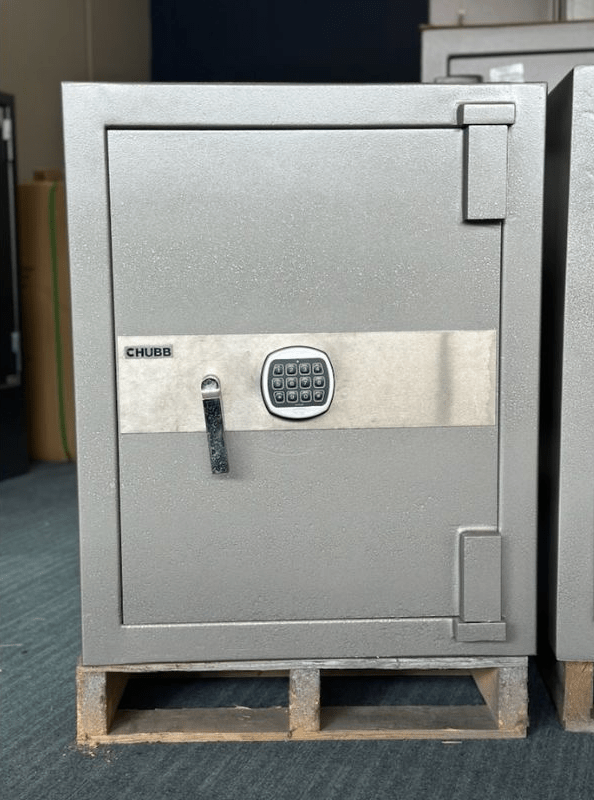
Few names in the security industry carry the legacy of Chubb. What began with a locksmith in Portsmouth solving a British Government security problem in the early 1800s grew into one of the world’s most recognised safe manufacturers, trusted by banks, institutions, and businesses across Britain and Australia. More than 200 years later, antique Chubb safes are still highly sought after for their craftsmanship, engineering, and historical significance, which is why many collectors and owners want to understand exactly what they have.
The Invention That Started It All: The Detector Lock (1818)
A Government Challenge and a Portsmouth Locksmith’s Answer
The story really starts with a burglary. In 1817, thieves used counterfeit keys to break into the Portsmouth Dockyard, an event significant enough that the British Government offered a reward of 100 guineas to anyone who could design a lock that could only be opened by its own key. The challenge was practical and urgent. Royal Navy stores, government depots, and banks were all using locks that could be picked or duplicated by anyone with the right skills, and the country needed something fundamentally better.
Jeremiah Chubb, who was working in Portsea as a ship’s outfitter and ironmonger with his older brother Charles, took up the challenge. On 3 February 1818, he was granted the patent for what he called the Detector Lock. It won the government reward, and within two years Jeremiah and Charles had moved their operations to Wolverhampton, the lockmaking capital of England, and founded Chubb Locks. From that single workshop, an entire industry of high-security mechanical engineering took shape.
How the Mechanism Actually Worked
The genius of the detector lock wasn’t just that it resisted picking. Plenty of locks at the time were difficult to pick. The breakthrough was what happened when someone tried. If any of the lock’s internal levers was lifted slightly higher than its correct position, whether by a pick, a false key, or even the wrong key inserted by mistake, a separate detector spring would snap into place and jam the entire mechanism. The lock then refused to open even with the correct key until it was reset using a special regulating key (and after the 1824 improvement patent by Charles, simply by turning the original key in the opposite direction).
What this meant in practice was revolutionary for the period. The owner of a Chubb-protected property would know, the moment they tried to open the lock, that someone had attempted to tamper with it. By 1847, the design had evolved into a six-lever version, and the addition of the “curtain” (a rotating disc that obscured the lever positions through the keyhole) made the lock even harder to manipulate. These same principles still underpin many of the lever locks fitted to safes built well into the twentieth century.
From Locks to Steel Vaults: Building Victorian Credibility
The 1835 Burglary-Resistant Safe Patent
A reputation built on locks doesn’t automatically translate into a reputation for safes, but Chubb closed that gap quickly. In 1835 the company registered its first patent for a burglary-resistant safe, and by 1837 it had opened a dedicated safe manufacturing factory at Cowcross Street in London’s Smithfield. The combination of an industry-leading lock with a properly engineered steel body gave Chubb something its competitors couldn’t match.
By the middle of the century, Chubb safes and strongroom doors were being installed in some of the most prestigious institutions in Britain. The Bank of England commissioned Chubb work. The Duke of Wellington had Chubb locks fitted at Apsley House. Royal Warrants were granted, and the company became the official supplier of locks to both the Post Office and HM Prison Service. By the time Queen Victoria visited the Chubb display at the Great Exhibition of 1851, the brand was already shorthand for the highest standard of mechanical security money could buy.
The 1851 Great Exhibition and Alfred C. Hobbs’ Challenge
No honest history of Chubb leaves out the Hobbs episode. The detector lock had stood unpicked for thirty-three years when American locksmith Alfred Charles Hobbs publicly announced he could open one. After a supervised attempt on a Chubb lock fitted to a vault door in Westminster, he did exactly that in twenty-five minutes, then relocked it cleanly seven minutes later.
What’s interesting is what the company did next. Within about a year, Chubb had introduced the “barrel and curtain” modification, a design by locksmith Charles Aubin that shielded the lock levers from any visual or physical inspection through the keyhole. Earlier locks were retrofitted. The incident, which could have been a disaster for the brand, instead became evidence of how seriously the company took its engineering. That institutional response is a large part of why the Chubb name still carries authority today.
Chubb in Australia: A 130-Year Local Presence
The 1896 Subsidiary and Its Legacy on Australian Soil
Chubb’s international expansion started in the 1870s with a United States subsidiary, and the Australian subsidiary followed in 1896. There has now been a continuous Chubb presence on Australian soil for roughly 130 years. For most of that time, Chubb safes were the default specification for banks, insurance offices, pharmacies, gold buyers, and substantial retail businesses across every state.
The practical result is that Australia has an unusually deep stock of antique and mid-century Chubb safes still in circulation. Many came out of bank decommissionings during the latter half of the twentieth century. Others surfaced when family pharmacies or jewellery businesses changed hands. We regularly see Chubb pieces here at MSC SafeCo that have spent their working lives within a few kilometres of where they were first installed, and quite a few end up restored and offered through our antique safes collection once they’ve been brought back to proper working order.
Why Antique Chubb Safes Are Still Sought After
Built to a Standard, Not a Price Point
When you handle one of these safes (particularly anything pre-1950) you immediately notice the weight of the steel, the precision of the boltwork, and the deliberate engineering of every component. The hinges are oversized. The bolt throw is generous. The lever locks engage with the kind of mechanical certainty that almost no modern budget safe can match. A well-maintained Chubb safe from a hundred years ago will still hold its function for another century with periodic servicing, which explains why so many small businesses, particularly jewellers and gold buyers, still actively prefer a properly restored vintage Chubb over the cheaper modern equivalents.
Provenance, Character, and the Collector’s Eye
The collector’s market values different things. Original paintwork, gilt lettering, intact interior fitments, the original keys, and any documentation tying a specific safe to a specific institution all add genuine value. A Chubb safe with its original brass nameplate showing a known bank or government department often carries a meaningful premium over an otherwise identical piece without that history. Beyond the investment angle, there’s also the visual presence. Antique Chubb safes have a confident, understated authority that suits both private collections and commercial settings.
Buying or Restoring a Vintage Chubb Safe in Perth
What to Consider Before Buying a Vintage Chubb Safe
Genuine Chubb safes vary enormously in condition. Before committing to a private sale or auction purchase, three things matter. The lock should function or be capable of being made to function without major reconstruction. The body should be structurally sound, with no significant rust-through or repair welds in critical areas. And the provenance should make sense, with maker’s plates, serial numbers, and any internal markings consistent with the date the safe is represented as. A safe that needs new hinges, lever work, and a full restoration service may still be a good buy if the price reflects the work involved.
How MSC SafeCo Can Help: Restoration, Servicing, and Second-Hand Stock
We’ve been working with antique Chubb safes for decades. Common services include opening seized mechanisms non-destructively, sourcing replacement components, refitting original lever locks, and where appropriate, fitting a modern lock upgrade that preserves the safe’s external character while bringing its security up to current standards. If the original key is lost, we can cut a replacement Chubb key from the existing lock, and a full combination change and service will reset the safe to a known working state.
For owners moving a heavy Chubb piece into a new home or commercial site, our specialist installation and relocation service handles the physical side of getting these substantial old safes safely into position. Anything beyond routine attention goes to our safe repair team. And for buyers who’d prefer to skip the inspection risk of a private purchase, our refurbished second-hand stock rotates regularly and includes Chubb pieces we’ve assessed and restored in-house.
Looking at a Chubb safe and want an expert opinion? Drop into the MSC SafeCo showroom at Shop 2-3/227 Main Street, Osborne Park, or call us on (08) 9344 1962. We’ve assessed hundreds of Chubb safes and we’re happy to give you a straight answer.