
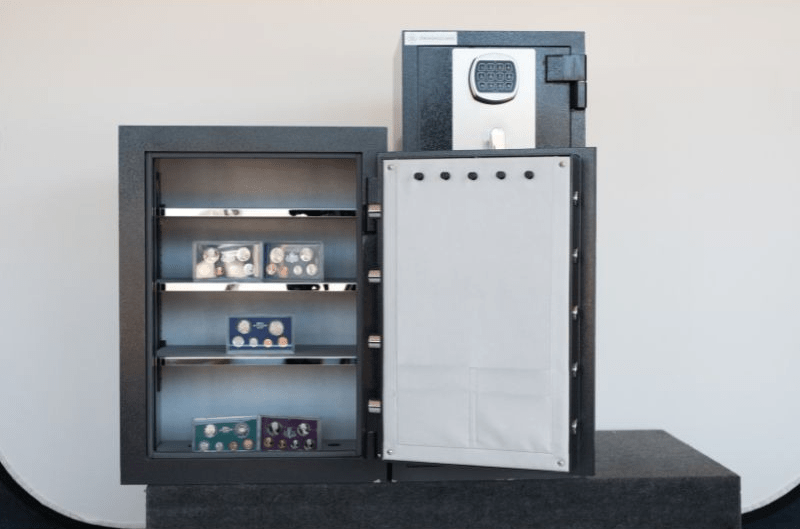
 One of the most common questions we hear at the showroom is whether someone needs a jewellery safe specifically, or whether a general home safe will cover the job. The terms get used interchangeably online, which makes the answer harder to pin down than it should be. The truth is they’re related products with genuinely different priorities, and knowing the difference will save you both money and regret.
The short answer is that a home safe is a generalist designed to protect a mix of typical household valuables, while a jewellery safe is a specialist built to handle higher-value, smaller-format items where the security demands step up. Both have their place. Which one you need depends on what you actually own, what your insurer expects, and how your collection is likely to evolve over the next few years.
What a Home Safe Is Actually Designed For
General Protection for Documents, Cash, and Mixed Valuables
A standard home safe is built around a balanced set of priorities. It needs to offer reasonable forced-entry resistance, a workable fire rating for paper documents, and enough internal space to hold a typical mix of household valuables. That usually means passports, birth certificates, modest amounts of cash, a few pieces of meaningful jewellery, perhaps a watch or two, and the odd hard drive or memory card. For the average household protecting up to around 25,000 dollars in total value, a quality general-purpose home and jewellery safe covers the job comfortably and within a sensible budget.
Where the Standard Home Safe Stops Being Enough
The point at which a home safe stops being the right answer is usually defined by two things. The first is total value. As insured valuables climb past about 30,000 to 50,000 dollars, the cash rating on most standard home safes simply doesn’t keep pace with what your insurer wants documented. The second is the nature of the contents. A collection that’s heavy on jewellery and watches, particularly compact high-value pieces, attracts a different category of attack than a safe storing mostly paper and cash. At that point, you’ve outgrown the home category, even if your house hasn’t.
What Makes a Jewellery Safe a Jewellery Safe
Forced-Entry Resistance Beyond General Home Specs
A jewellery safe is engineered for a specific threat profile. Because the contents are small, valuable, and easy to pocket, the entire economic logic of a break-in changes. A thief who reaches inside leaves with everything in seconds, so the safe’s job is to make sure they never reach inside in the first place. Jewellery-grade safes typically feature thicker steel, harder anti-drill plates, more sophisticated relocking devices,and at the highest tier, TDR (Torch and Drill Resistant) construction — engineered to defeat angle grinders, oxy-cutting tools, and determined mechanical attacks — for collections where the value justifies that level of protection. The step up in resistance is real and measurable.
Interior Organisation Built for Small, High-Value Items
The inside of a jewellery safe looks different from a general home safe, and that difference matters more than it first appears. Felt-lined drawers, dedicated ring rolls, watch slots compatible with winders, and necklace hangers keep pieces separated and prevent the kind of scratching and tangling that costs jewellery owners thousands over the life of a collection. For watch collectors in particular, the difference between sitting in a felt-lined slot and sliding around a metal shelf is the difference between a watch keeping its case condition and gradually losing it.
Cash Ratings That Match Jewellery Insurance Requirements
The third defining feature is the rating itself. Jewellery-grade safes typically carry significantly higher cash ratings, often 50,000 dollars unsupported and 100,000 or more supported, which aligns with the cover levels insurers expect for serious jewellery and watch collections. This is the practical reason many buyers end up in the jewellery category, whether they expected to or not. Once your insurer documents what they expect, the rating requirement pushes you out of the general home tier and into specialist territory.
How to Decide Which One You Actually Need
Total Insured Value as the First Decision Point
The cleanest way to make this decision is to start with your insurance schedule, not the showroom. Call your contents insurer and ask what total value of jewellery is currently scheduled on your policy, and what safe rating they require for that level of cover. The answer often surprises people in both directions. Some discover their collection has crept past the threshold for a general home safe without realising, while others find their existing setup is more than adequate.
Watches, Engagement Rings, and Collections That Grow Over Time
Most buyers underestimate the growth curve. A single significant watch turns into three. An engagement ring is joined by an eternity ring and an anniversary piece. The safe that fits your current valuables may not fit them five years from now, and upgrading later costs significantly more than buying once for where you’re heading. If you’re already at the upper end of what a home safe handles comfortably, a jewellery-grade unit is usually the more economical choice over a ten-year horizon.
When a Business or Commercial Setting Changes the Answer
For jewellers, watchmakers, and gold buyers storing significant inventory or client property, the question is different again. Business insurance brings stricter requirements, and stock left onsite overnight needs commercial-grade protection beyond residential ratings. For these buyers, our office and commercial safes range includes TDR-rated jewellery safes suited to both high-end residential collectors and small businesses with serious stock protection needs.
Matching the Right Product to the Real Need
The honest summary is straightforward. If your valuables fit comfortably within standard household contents cover and your jewellery holdings are modest, a quality general-purpose home safe with proper anchoring and a fire rating that suits your documents will do the job for years. If your collection has grown past that threshold, or if your insurer is asking for a higher cash rating than a general home safe carries, you’ve stepped into jewellery safe territory and the upgrade is genuinely worthwhile. And if you’re operating a business or storing institutional-level value, the commercial range is where the conversation should start.
There’s no prize for buying more safe than you need, and no recovery from buying less than you do. The right product is the one that matches your actual situation, and a five-minute conversation with our team in Osborne Park will usually tell you exactly which side of the line you’re on.
Not sure which category fits your situation? Bring your insurance schedule (or just your best estimate of what you own) into MSC SafeCo at Shop 2-3/227 Main Street, Osborne Park, WA, or call us on (08) 9344 1962. We’ll point you to the right tier, not the most expensive one.