
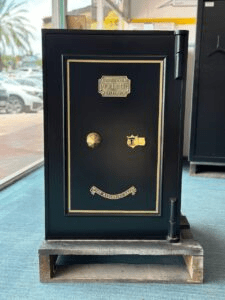
 It is one of the most common questions we get asked at the showroom. Someone has inherited a beautiful Victorian Chubb, or they’ve found a Wormald piece at auction, and they want to know whether it can still be trusted with cash, jewellery, or sensitive documents. The honest answer is more nuanced than either side of the marketing fence will tell you, and that nuance is exactly what this blog is for.
The short version is that a well-built antique safe can still provide meaningful security for the right contents, but it falls short of modern standards in specific and measurable ways. Knowing which side of that line your situation sits on is the difference between a piece that genuinely protects what you care about and one that gives you a false sense of confidence.
Understanding What You Actually Have: Practical Use vs Collecting
What Makes Some Antique Safes Worth More Than Others
Not every antique safe holds its value the same way. The pieces that tend to appreciate are those with documented provenance from recognised manufacturers, intact original detailing, and mechanical condition that is either sound or economically restorable. A genuine Chubb and Sons safe from the Victorian period with its original gilt lettering, working lever lock, and brass furniture is a different proposition from an unidentified safe of similar age in rough condition. The first is an asset that often appreciates with time. The second is decoration with a price tag.
Choosing the Right Safe for Practical Use vs Collecting
Buyers come to antique safes for two different reasons, and the choice depends on which side of that line you’re on. If you want a piece that holds its value, anchors a room, and stores moderate valuables, condition and provenance matter most. If you want active security for substantial cash or insured jewellery, an antique alone is unlikely to be the right fit, and you’ll usually do better either by upgrading the antique with modern components or by adding a contemporary safe alongside it. Both paths are valid, but they lead to different products.
What Antique Safes Still Do Well
Weight, Mass, and the Deterrence Factor
The first thing antique safes have going for them is sheer physical mass. A Victorian banker’s safe regularly weighs more than a small car, which fundamentally changes the economics of a burglary. Modern home break-ins typically run on a tight clock, and an opportunistic intruder is not going to attempt to remove several hundred kilograms of cast iron from a property within that window. Properly anchored, even a modest 200-kilogram antique becomes a piece of permanent furniture rather than a removable target.
Mechanical Lever Locks Are Harder to Defeat Than People Assume
There is a common assumption that older lever locks are easy to pick. In practice, a well-engineered seven or eight-lever Chubb mechanism with a curtain plate and detector spring requires real skill, time, and silent working conditions to manipulate. Most modern burglaries don’t involve lock-picking at all. They involve carrying the safe away to be defeated at leisure, or attacking the body of the safe with whatever tools are at hand. A functioning antique lock is far from the weakest link in most security pictures.
Where Antique Safes Fall Short Against Modern Threats
No Current Fire Rating or Drop Protection
This is one of the limitations most worth being honest about. Modern fire-rated safes are tested to specific standards, typically protecting paper documents for thirty to sixty minutes at oven temperatures of around 900 degrees. Most antique safes were built before standardised fire testing existed, and even those originally advertised as fire-resistant relied on insulation materials that have likely degraded over a century of use. The same applies to drop testing, which simply wasn’t part of the original specification. If protecting documents through a house fire is a genuine concern, an antique is not the right tool for that job on its own.
Vulnerability to Modern Power Tools and Angle Grinders
A cast-iron body that resisted Victorian-era cutting tools is still vulnerable to a modern cordless angle grinder. Given enough time and noise tolerance, a determined attacker with a power tool can cut through most antique safe walls in a fraction of the time it would have taken in the nineteenth century. This matters less than it sounds in typical residential settings, where opportunistic burglars rarely carry grinders, but it does matter for high-value contents that might justify a more sophisticated attack. Modern TDR-rated safes are specifically engineered to resist these tools. Antiques are not.
The Australian Cash Rating and Insurance Problem
Australian insurance providers typically require a documented cash rating from the safe’s manufacturer to cover valuables above modest thresholds, and antique safes simply don’t carry these ratings. The result is that even a genuinely robust antique may not satisfy your insurer for high-value cover. Before storing anything of significant insured value in an antique, it is worth checking your policy. Many owners discover at claim time that the safe they trusted wasn’t actually recognised by their cover.
Practical Use Cases: What an Antique Safe Is Genuinely Suited For
Documents, Heirlooms, and Moderate-Value Jewellery
Where antique safes genuinely earn their keep is the middle of the value range. Personal documents, passports, family papers, sentimental jewellery, watches of moderate value, and modest cash holdings all sit comfortably within what a well-anchored antique can protect. The combination of weight, working mechanical lock, and the deterrence value of a piece that clearly looks substantial covers this use case effectively. Many of the pieces in our antique safes collection are bought specifically for this kind of everyday protection, where the buyer wants something with character that still does a job.
Where We’d Recommend a Different Solution
There are situations where we tell people honestly that an antique is the wrong tool. Large cash holdings, gold bullion, high-value watch collections, firearms storage with legal compliance requirements, and businesses with insurer-mandated security standards all call for modern safes with documented ratings. In these cases, the right answer is often a contemporary safe for active security and an antique alongside it for the items where its qualities are genuinely sufficient.
Bringing an Antique Safe Up to Modern Security Standards
Modern Lock Upgrades Without Compromising Character
For owners who want to retain the antique character but improve real-world security, the most effective intervention is usually a lock upgrade. A modern high-security mechanism can often be fitted within the original lock cavity, preserving the external appearance of the safe while bringing the actual locking standard up to current expectations. Our lock upgrade service handles this on antique bodies regularly, with the original lever lock either kept in place as a decorative element or properly retired. The result is a piece that still reads as an antique but functions to a contemporary standard.
Anchoring, Placement, and Layered Security
The single biggest security improvement you can make to any safe, antique or modern, is to anchor it properly. An unanchored 300-kilogram safe is a target that takes effort but can be removed. An anchored one of the same weight is a target that cannot. Our installation team bolts antique safes through the base into concrete, timber, or steel, depending on the floor type, and pairs that with placement decisions that reduce visibility from windows and entry points. The safe itself is one layer. Alarms, lighting, and a sensible position do the rest.
Talk to MSC SafeCo Before You Decide
Whether you’ve inherited a piece you’re not sure about, you’re considering a purchase, or you already own an antique and want it brought up to a current standard, we’d encourage a conversation before you commit either way. The right answer depends on what you’re storing, what your insurer expects, and what mechanical condition the safe is actually in, and these things are easier to assess in person than from a listing photograph. Our servicing team can also test an antique’s mechanism, confirm whether the existing lock is reliable enough for daily use, and give you a candid assessment of what would need attention to make it fit your purpose.
Want a straight answer on a specific safe? Visit MSC SafeCo at Osborne Park, WA, or call us on (08) 9344 1962. We’ve assessed thousands of antique safes and we’re happy to tell you honestly whether yours is right for the job you have in mind.