
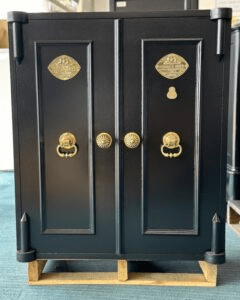
Over the years we’ve watched the market for antique safes shift in an interesting direction. Where once they were bought almost exclusively for their function, today a meaningful slice of our customers come through the door looking for something else entirely. They want a piece with provenance, presence, and craftsmanship. They want a story that lives in their study, their bar, or their entrance hall. This blog is for those buyers, the ones whose primary question is not how much it can hold but how it will sit in the room.
Why Antique Safes Still Stand Out in Modern Spaces
Craftsmanship and Materials You Rarely See Today
The construction of a Victorian or Edwardian safe belongs to a different era of manufacturing. Each one was built by hand from cast iron and forged steel, with hinges and bolt work fitted to tolerances that were measured by eye and refined by experience. The lettering on the door was often gilded and painted in by signwriters whose work survives intact more than a century later. The interiors were lined with timber, fitted with hand-cut drawers, and finished with brass furniture that softens beautifully as it ages.
Modern manufacturing produces excellent safes, but it does not produce this. The sheer weight of materials, the slow patina, and the visible evidence of hand-finishing are part of what makes an antique safe register as something more than functional.
Adding Character Beyond Standard Modern Interiors
Contemporary interiors tend to favour clean lines and a certain restraint in material choice. That restraint can leave rooms feeling thin when everything in them is new. An antique safe introduces mass, history, and a touch of friction that grounds the space around it. They work particularly well in spaces that already balance old and new, such as a converted warehouse loft, a heritage cottage with modern fittings, or a hotel lobby that mixes era influences.
Different Styles of Antique Safes and What They Bring to a Space
Victorian Parlour Safes and Their Decorative Heritage
Victorian-era safes from the second half of the nineteenth century are some of the most decorative pieces ever produced. The door faces were treated almost like canvases, with hand-painted gold leaf lettering announcing the maker’s name in elaborate script, often surrounded by floral motifs. Pieces from English makers like Hobbs, Chubb, and Taylor Moore exemplify this period beautifully, and in a study or library they lend a layer of literary character that modern reproductions cannot replicate.
Cast-Iron Banker’s Safes and Industrial Character
At the other end of the spectrum sit the heavier banker’s safes from the late Victorian and Edwardian periods. These are imposing pieces, often weighing several hundred kilograms, with thicker doors, oversized brass handles, and a stripped-back industrial aesthetic that suits modern interiors remarkably well. They pair naturally with exposed brick, polished concrete, and warehouse-style timber, which is why we often see them used as the anchor piece in home bars, whisky rooms, and behind retail counters.
French and European Safes with Hand-Painted Details
Continental European safes carry a different visual language. The proportions tend to be lighter, the painted details more ornate, and the interior fittings sometimes include velvet or silk linings. A piece such as the antique French safe currently in our collection, marked Coffre Incombustible Versaen Paris, brings a touch of Parisian provenance that suits softer, more decorated interiors like dressing rooms and entry halls.
The Collector’s Eye: What Makes a Vintage Safe Valuable as an Object
Maker, Provenance, and Original Detailing
Collectors tend to value the same handful of things, in roughly the same order. The maker matters first. A confirmed piece from a well-documented manufacturer such as Chubb and Sons, Hobbs and Co, or A Simpson and Son of Adelaide carries an automatic premium because the engineering is known. Provenance comes next, particularly safes with a known institutional history identified by an original brass plate. Original detailing is the third pillar, and many of the pieces in our antique safes collection are listed precisely because they retain intact gold lettering, original keys, and undisturbed paintwork.
Interior Finishes That Designers Look For
When designers open a safe for the first time, the interior tells them most of what they need to know about its history. A well-preserved timber lining, intact drawers with original brass pulls, and felt or velvet linings in good condition all point to a piece that was cared for through its working life. These details also expand the safe’s usefulness in a modern setting, making it a natural choice for watch storage, jewellery, or curated collections of small objects.
Practical Considerations Behind the Aesthetic
Weight, Placement, and Floor Loading
Heaviness is part of how an antique safe works visually. Once a piece passes a certain mass, the eye reads it differently, and it stops looking like furniture and starts looking like architecture. Designers use this deliberately, treating the safe as a fixed point that everything else arranges itself around. The trade-off is that placement decisions need to be made early, since heritage timber floors, suspended slabs, and tiled entrances all behave differently under sustained load. Our specialist installation team walks the route and handles the final positioning, which keeps the design conversation focused on where the piece belongs.
Restoration Versus Original Patina
Decisions about restoration matter as much as the safe itself. There is a meaningful difference between a piece that has been mechanically serviced while preserving its original surface, and one that has been stripped back and refinished to look new. For most collectors, the patina is part of the value, and the right approach usually sits in the middle. A safe should function mechanically, but beyond that, less intervention is often more. Our restoration service works in this conservative tradition, focusing on what genuinely needs attention while preserving the character that drew you to the piece.
Sourcing and Restoring Your Own Statement Safe Through MSC SafeCo
Finding the right antique safe takes time, and that part of the process is half the pleasure. The pieces that rotate through our Osborne Park showroom each carry their own history, and standing next to one tells you more than any photograph. The proportions, surface, and weight communicate something a listing cannot capture, which is why we encourage clients with serious design or collecting interests to drop in.
Beyond the antique range, our refurbished second-hand stock often includes mid-century pieces with strong design credentials at more accessible price points. For collectors moving into mechanical horology, we also produce custom watch winder safes that pair naturally with a restored vintage piece.
Looking for a vintage safe to anchor your space? Drop into MSC SafeCo at Osborne Park, WA, or get in touch with our teamon (08) 9344 1962. We’re happy to walk you through what’s in stock and what might suit the room you have in mind.